The Elder or Sambucus nigra Part 1 of the Adoxaceae or Elder family.

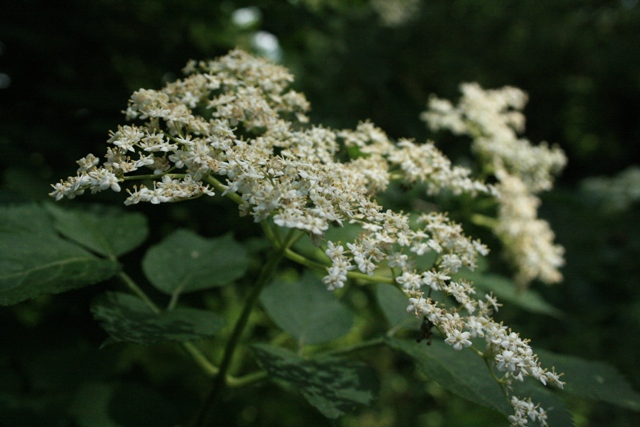
Sambucus nigra or Common Elder is a hugely useful plant and therefore cannot be called a weed at all!

It used to be a member of the Caprifoliaceae but now it belongs in the Adoxacea together with Viburnum and Adoxa with the most modern thinking in Plant Taxonomy.

I use colour coding for easy reading! Blue background is general interesting info (although I hope you find it all interesting!!). Green is about all the uses except for medicinal uses or if there is a warning in which case I use a pink background. Pictures and the poem on the end by Matt Summers. Most information in the post comes from Plants for a Future and Wikipedia and links are provided to their websites and relevant pages.

Contents:

Sambucus nigra or Common Elder

Ornamental Uses

Edible Uses

Medicinal Uses:

Other Uses:

A Poem: ‘WITHIN THE GREEN’   (by Matt Summers)

Sambucus nigra or Common Elder

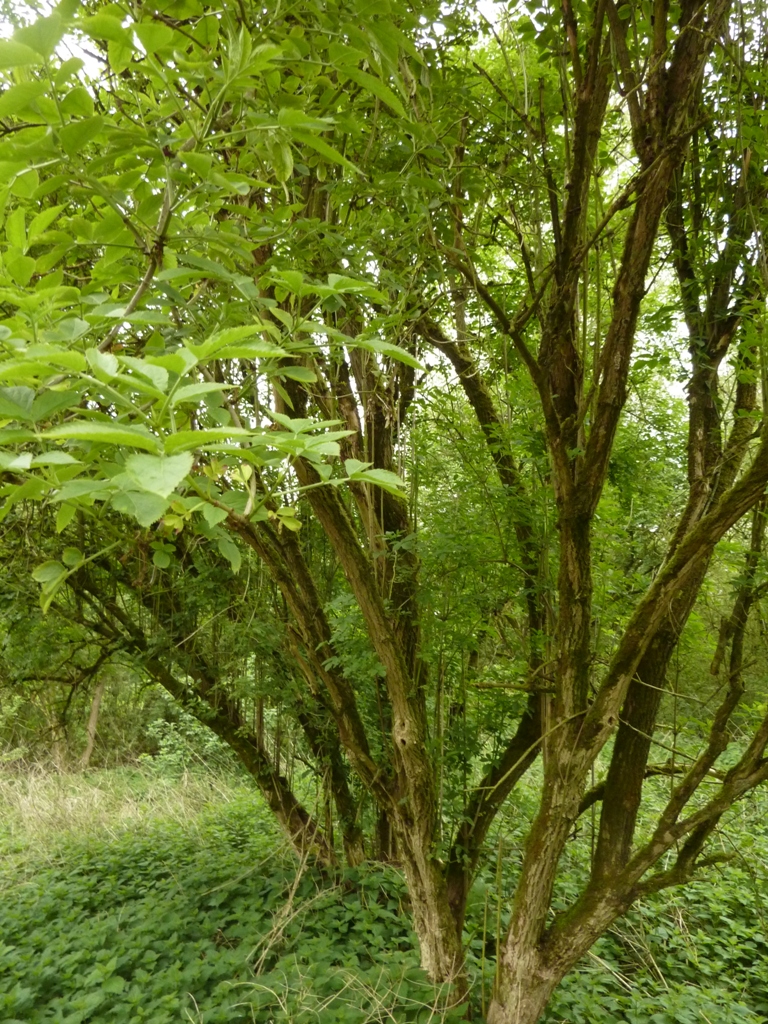
A deciduous shrub or small tree of fertile soils found in a wide range of habitats including woodland, hedgerows, grassland, scrub, waste ground, roadsides and railway banks. It is resistant to rabbit grazing and often occurs around warrens

Here first an extract from Natures Best Website about the elderberry:

For centuries, people have used the elderberry plant for its therapeutic properties. It was Hippocrates, the ‘father of medicine’, who first recognised the extraordinary health credentials of elderberries, using them to combat colds, flu, and allergies.

Elderberries are rich in tons of antioxidants, too (anthocyanidins, flavonols, and vitamin C, to be precise), meaning they also have the power to fight inflammation and free radical damage in the body. A report published in the Journal of International Medical Research revealed that when elderberries were consumed within the first 48 hours of catching flu, the symptoms dissipated approximately four days earlier than the average i. Plus, the use of pain relief was considerably less amongst those who received the elderberry compared to the placebo. When cold and flu season strikes, make sure your kitchen is well stocked with plenty of elderberry juice.

Ornamental Uses:

The common Elder is an attractive large shrub in all seasons for the garden and in farm hedges. The fragrant, creamy flower heads and dark burgundy bunches of berries are attractive for wildlife as well as for us.
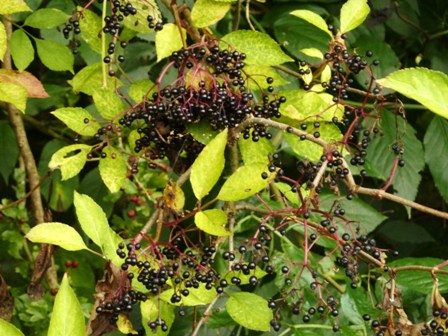
Even in autumn the pungent leaves (when bruised) are attractive when they colour creamy yellow to peach and burgundy. 

In winter when it’s leafless its silhouette is distinct with furrowed bark and sometimes with a common bright yellow lichen (Xanthoria parietina)  decorating its branches!

It is also host of the Common Ear-fungus or Auricularia auricula-judae often seen on dying or dead branches in older specimens.

If the common Elder is not attractive enough for the ornamental garden there are many named cultivars with various coloured and shaped leaves. ‘Hilliers Manual of Trees and Shrubs (my 5th Edition)’ mentioned 11 cultivars, but there are many more in the latest 2019 edition and also to be seen on the RHS website!
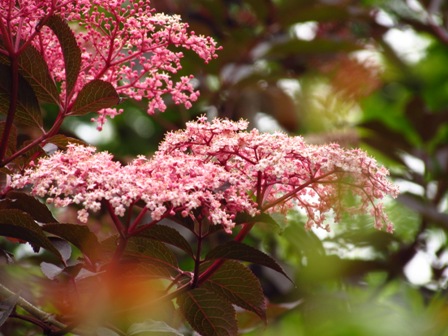
One purple leaved & pink flowered Elder as seen at John’s Garden in Ashwood.

Edible Uses:

There are many selected cultivars nowadays of the common elder with larger sized fruit, flowers and other qualities. See for many cultivars at the Agroforestry Research Trust shop.

Flowers:

  • The flowers can be eaten raw and apparently a delicious crisp and somewhat juicy snack on a summer’s day.
  • They can also be used in elderflower-fritters.
  • The flowers are used to add a muscatel flavour to stewed fruits, jellies and jams (especially gooseberry jam).
  • They are often used to make a sparkling wine.
  • A sweet tea is made from the dried flowers.

Fruit:

  • The flavour of the raw fruit is not acceptable to many tastes, though when cooked it makes delicious jams, preserves, pies and so forth.
  • The fruit is used to add flavour and colour to preserves, jams, pies, sauces, chutneys etc.
  • It is also often used to make wine.

Leaves:

  • These are used to impart a green colouring to oils and fats.

Medicinal Uses:

Most of this information has been copied of the PFAF website-database   ( Plants For A Future and I cannot take any responsibility for any adverse effects from the use of plants. Always seek advice from a professional before using a plant medicinally.

Elder has a very long history of household use as a medicinal herb and is also much used by herbalists. The plant has been called ‘the medicine chest of country people’.

The flowers are the main part used in modern herbalism, though all parts of the plant have been used at times.

Flowers:

  • The fresh flowers are used in the distillation of ‘Elder Flower Water’. It is mainly used as a vehicle for eye and skin lotions.
  • An infusion is very effective in the treatment of chest complaints and is also used to bathe inflamed eyes. It is a very good spring tonic and blood cleanser.
  • Externally, the flowers are used in poultices to ease pain and abate inflammation. Used as an ointment, it treats chilblains, burns, wounds, scalds etc.

Fruit:

  • The fruit is depurative, weakly diaphoretic and gently laxative.
  •  A tea made from the dried berries is said to be a good remedy for colic and diarrhoea.
  • The fruit is widely used for making wines, preserves etc., and these are said to retain the medicinal properties of the fruit.

Leaves:

  • The leaves can be used both fresh and dry. The leaves are purgative, but are more nauseous than the bark. They are also diaphoretic, diuretic,expectorant and haemostatic.
  • The juice is said to be a good treatment for inflamed eyes. An ointment made from the leaves is emollient and is used in the treatment of bruises, sprains, chilblains, wounds etc.

Bark and Pith:

  • The inner bark is diuretic, a strong purgative and in large doses emetic. It is used in the treatment of constipation and arthritic conditions. An emollient ointment is made from the green inner bark.
  • The pith of young stems is used in treating burns and scalds.
  • A homeopathic remedy is made from the fresh inner bark of young branches. It relieves asthmatic symptoms and spurious croup in children. The German Commission E Monographs, a therapeutic guide to herbal medicine, approve Sambucus nigra for cough and bronchitis, fevers and colds.

Other Uses:

Compost; Cosmetic; Dye; Fungicide; Hedge; Hedge; Insecticide; Litmus; Microscope; Musical; Pioneer; Pipes; Repellent; Wood.

  • The plant is a valuable addition to the compost heap, its flowers are an alternative ingredient of ‘QR’ herbal compost activator and the roots of the plant improve fermentation of the compost heap when growing nearby.
  • The leaves are used as an insect repellent; very effective when rubbed on the skin.
  • The flowers are used in skin lotions, oils and ointments.
  • Tolerant of salt-laden gales, this species can be grown as a shelter hedge in exposed maritime areas.
  • This is an excellent pioneer species to use when re-establishing woodlands. It is very tough and wind-resistant, grows quickly and provides shelter for longer-lived and taller woodland species to establish.

As Dye:

  •  bark of older branches and the root have been used as an ingredient in dyeing black.
  •  A green dye is obtained from the leaves when alum is used as a mordant.
  • The berries yield various shades of blue and purple dyes.
  • They have also been used as a hair dye, turning the hair black.
  • The blue colouring matter from the fruit can be used as a litmus to test if something is acid or alkaline. It turns green in an alkaline solution and red in an acid solution.

Pith and Wood Uses:

  • The pith in the stems of young branches pushes out easily and the hollow stems thus made have been used as pipes for blowing air into a fire.
  • They can also be made into musical instruments.
  • The pith of the wood is used for making microscope slides and also for treating burns and scalds.
  • The mature wood is white and fine-grained. It is easily cut and polishes well. Valued highly by carpenters, it has many used, for making skewers, mathematical instruments, toys etc.

Finally a poem by my partner Matt Summers about the virtue of the Elder:
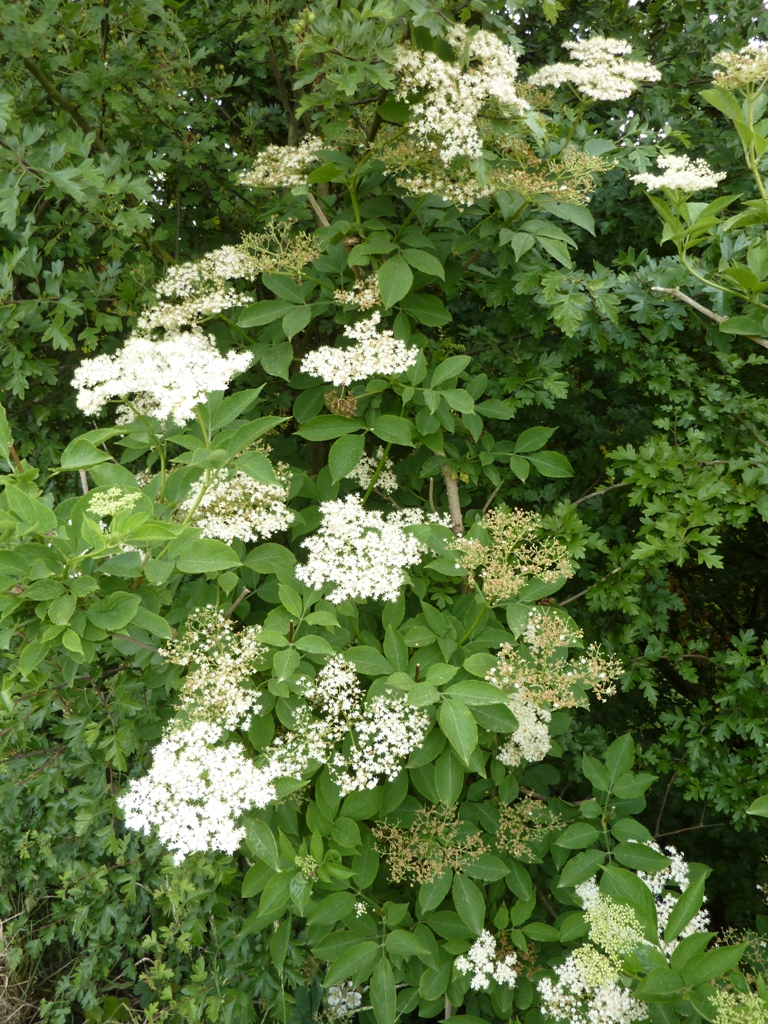
WITHIN THE GREEN  (by Matt Summers)

Flowers of purity

                                      Berries of beauty

                                                Elder statesman

                                                          Standing proud…

                             …Yet harmonious within the green

                             Lichen Winter branches

                                      Are as bare bones clutching

                                                The grey skies in waiting

                                                          For bud-break Spring…

                             …Sweet symmetry within the green

                             Blossom bleeds heavenwards

                                      In a cream cascade

                                                Showering clouds of Summer

                                                          Inviting insects inquisitive…

                             …A blazing torch within the green

                             As flowers fade

                                      Late Summer transformation

                                                Deep dark fruits

                                                          Blink as eyes opened in the depths…

                             …A harvest in waiting within the green

                             Fast falls the Autumn

                                      Yellowed keepsakes float with the year

                                                The final berry’s picked clean

                                                          This icon of the hedgerow…

                             …grows vigilant within the green

Honeysuckle and other genera from the Caprifoliaceae family

I was just reminded that The Elder does not belong into the Caprifoliaceae family any longer but is now in the Adoxaceae family together with genus Viburnum which also used to be in the Caprifoliaceae!

Adoxacea is now family number 137 and Caprifoliaceae follows with number 138 in Stace.

But the Lonicera or Honeysuckle remains in the Caprifoliaceae or Honeysuckle family.

I use colour coding for easy reading! Blue background is information of the habitat from Plant Atlas 2020 and for the general interesting info (although I hope you find it all interesting!!). Green is about all the uses except for medicinal uses or if there is a warning in which case I use a pink background. The link on the Scientific name is mostly from Online Plant Atlas 2020 and the link on the Common Name is from Wikipedia or other websites for more information on Uses and pictures of the plants. Pictures by Matt Summers unless stated.

Contents:

Lonicera or Honeysuckles

L. periclymenum or Common Honeysuckle

L. xylosteum or Fly Honeysuckle

Other neophyte species:

Other native species in Caprifoliaceae

Linnaea borealis or Twinflower

Other non native plants in the Caprifoliaceae

Leycesteria formosa or Himalayan Honeysuckle

Symphoricarpos albus or Snowberry

Symphoricarpos orbiculatus or Coralberry

Common Honeysuckle (by Matt Summers)

Lonicera or Honeysuckle

There are 5 different species of the climbing and shrubby honeysuckles mentioned in the Wild Flower Key and 11 are mentioned in the Plant Atlas 2020 but only one is native.

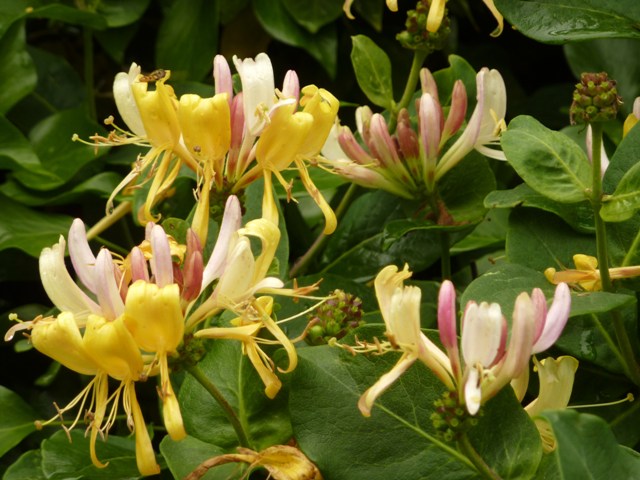
Lonicera periclymenum or Common Honeysuckle

A perennial deciduous twining shrub or woody climber, found in woodland, scrub and hedgerows, and on shaded rocks. It prefers freely drained, moderately basic to acidic soils, but also grows on poorly drained base-rich clays.

It is a much loved wild flower as the flowers are highly scented by night, much less so by day. The plant is usually pollinated by moths or long-tongued bees and develops bright red berries.

Mythology and Symbolism:

It was once believed that if honeysuckle grew around a home’s entrance, it would bring good luck and stop any evil spirits from entering. It has also long been considered a symbol of fidelity, and in Victorian times young girls were banned from bringing honeysuckle into the house because it was believed the strong smell would make them have suggestive dreams!

Ornamental and Other Uses:

Lonicera periclymenum is one of several honeysuckle species valued in the garden, for its ability to twine around other plants, or to cover unsightly walls or outbuildings; and for the intense fragrance of its profuse flowers in summer. It needs to be planted with its roots in the shade, and its flowering top in sun or light shade.

Plants need to be chosen with care as they can grow to a substantial size. The cultivars ‘Graham Thomas‘ and ‘Serotina’ have gained the Royal Horticultural Society‘s Award of Garden Merit.

Honeysuckle has been used to make beautiful walking sticks which were once popular with Scots music hall performers. They were created as the honeysuckle entwined itself around branches, causing the branches themselves to become twisted. 

While the berries are poisonous, the leaves, flowers and seeds have been used for medicinal purposes for a variety of conditions.

Uses for Wildlife:

Dormice make summer nests for their young from honeysuckle bark; they also eat the flowers, which are a good source of energy-rich nectar. Night-flying moths such as the hummingbird hawk-moth can detect the scent of honeysuckle flowers up to a quarter of a mile away. The clusters of red berries are eaten in the autumn by birds such as thrushes, bullfinches and warblers.

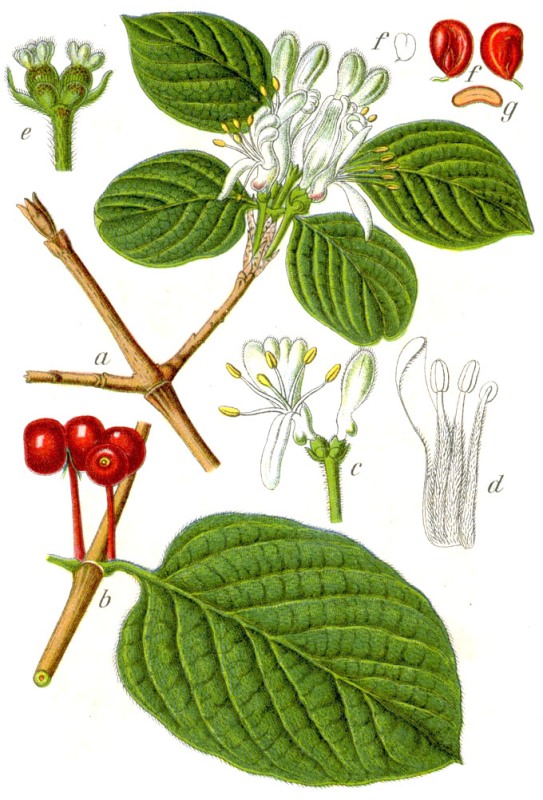
From a drawing by Johann Georg Sturm (Painter: Jacob Sturm)

The second common one is probably:

Lonicera xylosteum or Fly Honeysuckle

A deciduous shrub, formerly considered to be native in woodland on chalk in south-eastern England but also widely naturalized on free-draining basic or neutral soils in open woodland, hedgerows and scrub.

L. xylosteum was being cultivated in Britain by 1596. It was first recorded in the wild as a casual in 1770, it has been known from the chalk escarpment of the South Downs near Amberley (West Sussex) since 1801, where it grows in ancient woodland, hedgerows and scrub. Although arguably native there, it is considered to be an introduction given the lateness of its discovery, use as a garden plant and the frequency of introduction elsewhere (Webb, 1985; Pearman, 2007).

Ornamental Uses:

This is a dense, bushy, deciduous shrub, to 3m tall, with grey-green foliage. Small, tubular, two-lipped, creamy-white flowers are produced in pairs along the shoots in late spring and early summer, followed by showy red, or rarely yellow, berries

The glossy red (or occasionally yellow) berries of this shrub are mildly poisonous to humans – children who ingest a large number (c. 30) of berries may experience abdominal pain and vomiting.

Other species found on the British Isles are:

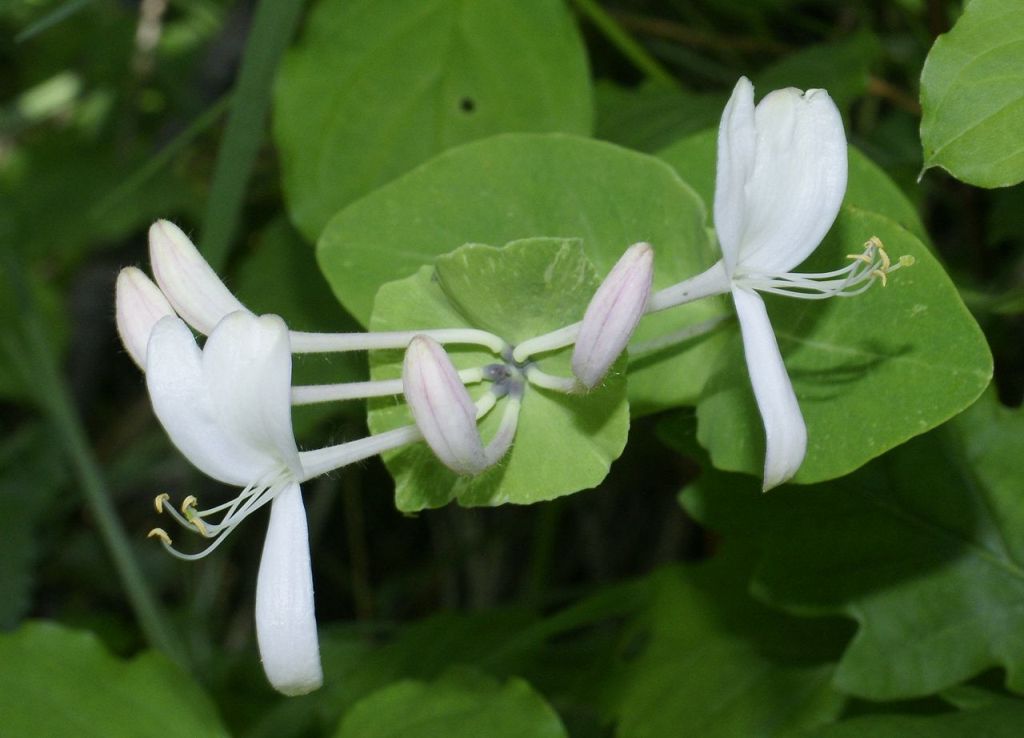
L. caprifolium or Perfoliate Honeysuckle by Robert Flogaus-Faust in Wikipedia

A twining, deciduous climber, naturalized in woodland, scrub and hedgerows, perhaps establishing mainly from bird-sown seed from garden plants

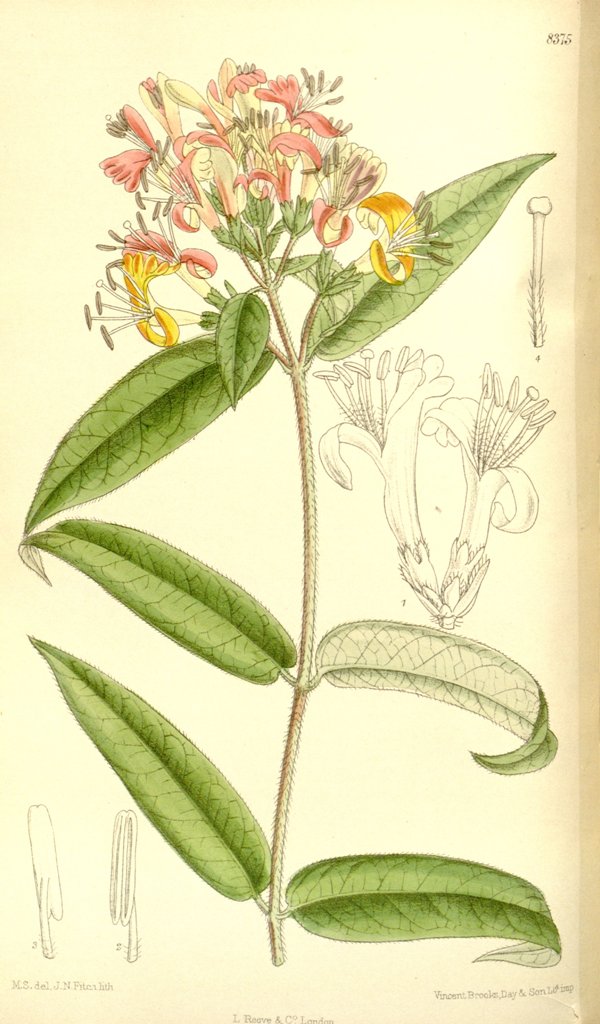
L. henryi or Henry’s Honeysuckle (illustration by M.S. del., J.N.Fitch lith. – Curtis's Botanical Magazine, London., vol. 137 [= ser. 4, vol. 7]: Tab. 8375 – [1], Public Domain,)

A winter-green or semi-deciduous climbing shrub, naturalized on woodland margins and in hedgerows and rough grassland. It arises as a garden escape or throw-out, and is seldom found far from human habitations. It is also capable of reproducing from seed, which can be bird-sown.

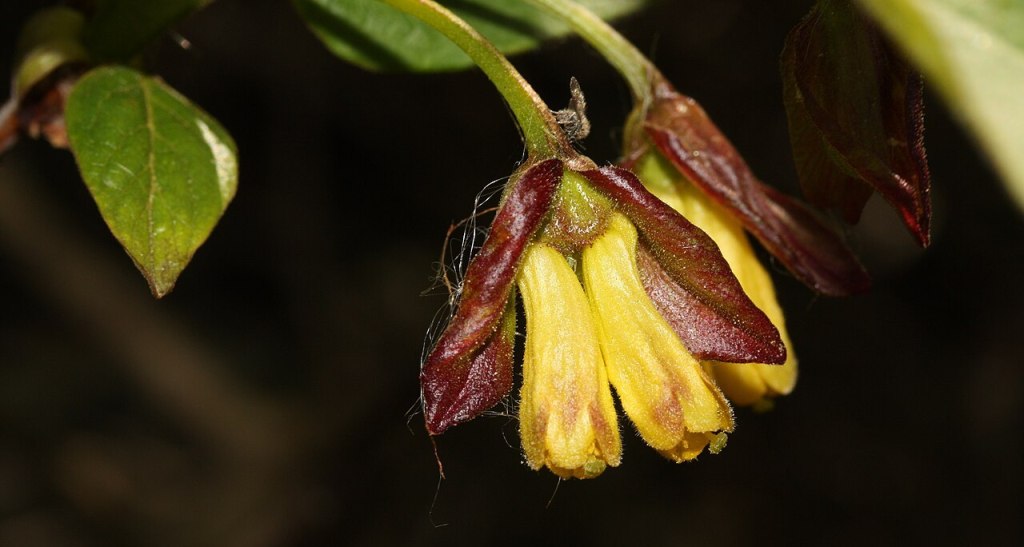
L. involucrata or Californian Honeysuckle (by Walter Siegmund in Wikipedia)
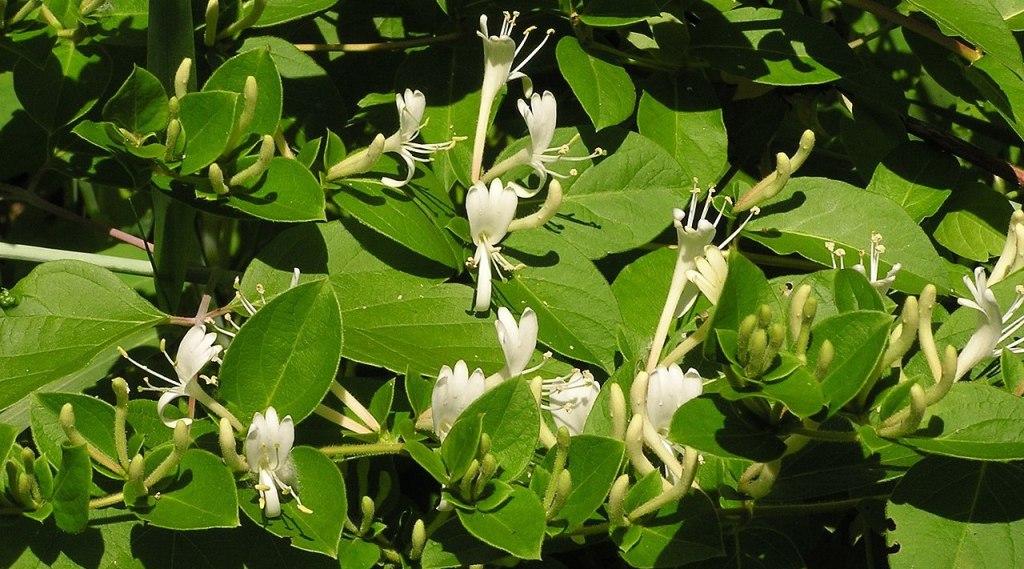
L. japonica or Japanese Honeysuckle (by SB_Johnny in Wikipedia)

A partially winter-green climbing shrub, widely grown in gardens and frequently spreading to woodland margins, scrub, hedgerows and on waste ground, sometimes forming extensive thickets but seldom far from human habitations. Naturalized plants are often self- or bird-sown, but occasionally originate from dumped garden waste. 

Ornamental, Edible and Medicinal Uses:

 The cultivars Halliana is well known and I like the cultivar ‘Aureoreticulata’ for its interesting netted foliage! The variety L. japonica var. repens has gained the Royal Horticultural Society‘s Award of Garden Merit.

Japanese honeysuckle flowers are edible to humans and appreciated for their sweet-tasting nectar. The flowers can also be a significant source of food for deer, rabbits, hummingbirds, and other wildlife.

It is an effective groundcover and has strong-smelling flowers.

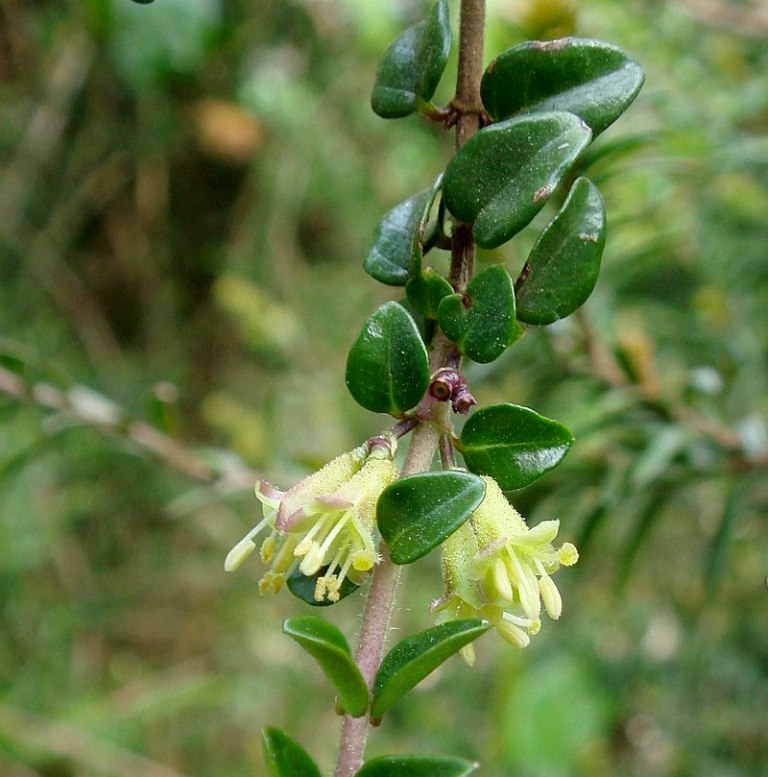
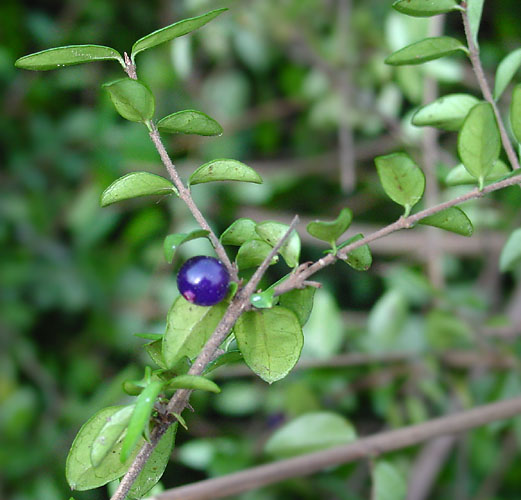
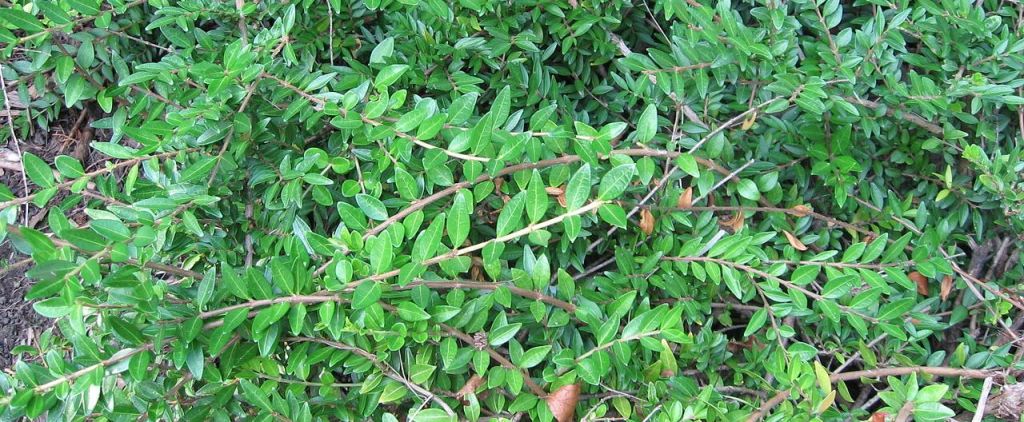
Lonicera nitida or Wilson’s Honeysuckle (flowers & fruit by Wouter Haagens)

L. pileata or Box-leaved Honeysuckle (by Chhe (talk) in Wikipedia)
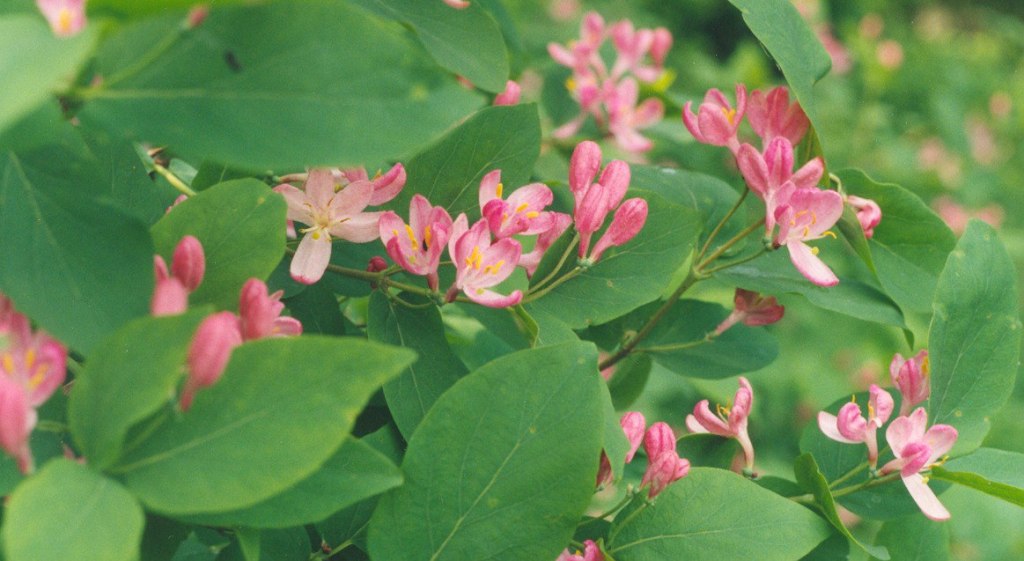
L. tatarica or Tartarian Honeysuckle (by Algirdas in Wikipedia)

Other genera in Caprifoliaceae

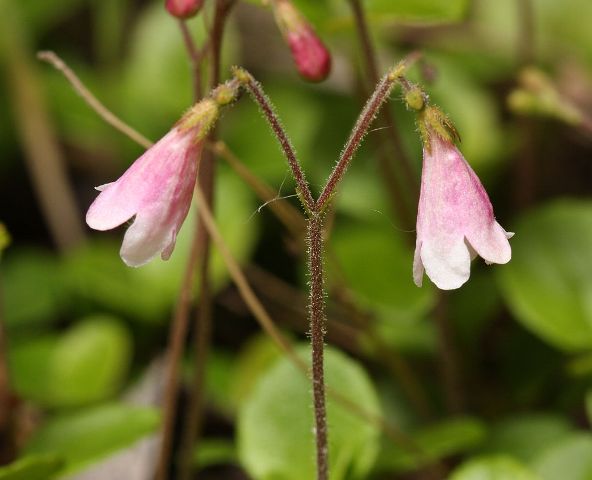
The apt named Twinflower by Walter Siegmund (Wikipedia)

Linnaea borealis or Twinflower

A mat-forming creeping perennial herb of native pinewoods and plantations of Pinus sylvestris, occasionally in birchwoods, and rarely, as a relict of former woodland cover. Populations are fragmented, as a result of loss of pinewood habitat, into a series of (mainly) self-incompatible populations.

The genus Linnaea was first formally described by Carl Linnaeus. The name had been used earlier by the Dutch botanist Jan Frederik Gronovius, and was given in honour of Linnaeus. Linnaeus adopted the name in 1753 inSpecies Plantarum for the then sole species Linnaea borealis, because it was his favourite plant.

L. borealis is a creeping, mat-forming shrub with small, glossy, dark green leaves with buff undersides. In summer pairs of small, pale pink, nodding, bell-shaped flowers are produced from the tips of leafy side shoots. Overall the plant is only 8cm high, but can spread to a metre or more across.

Other non native plants in the Caprifoliaceae

There are several other ornamental escapees on the British Isles in both the honeysuckle genus (Lonicera spp.) as well as different genera.

Two more well known wonderful weedy types below:

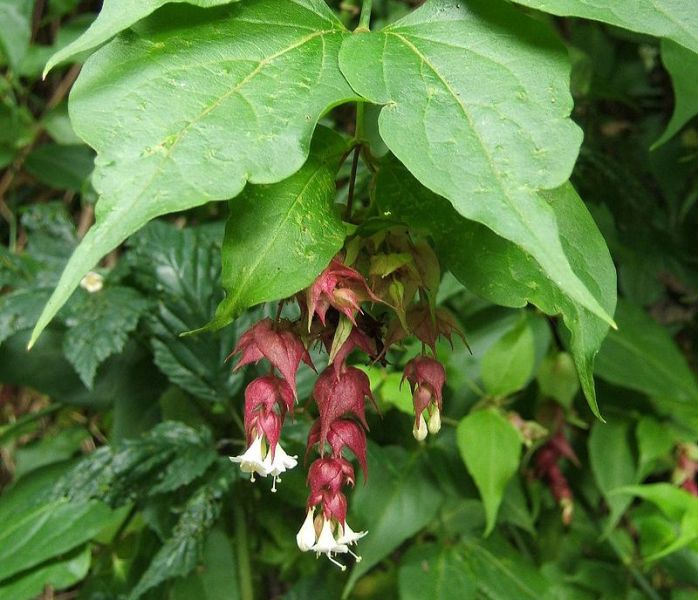
Leycesteria formosa close up (Wikipedia)

Leycesteria formosa or Himalayan Honeysuckle

A deciduous shrub, widely grown in gardens, and frequently established as a garden escape on walls and at the base of hedgerows, in woodland and shrubberies and on waste ground, mainly in urban areas. Most plants appear to be bird-sown but it is also planted as cover for pheasants.

Uses:

This is a lovely and interesting ornamental which was favoured by the Victorians. It has occasionally escaped into the wild. Also attractive to wildlife for its flowers as well as berries.

Leycesteria formosa, or the Himalayan honeysuckle, Flowering nutmeg, Himalaya nutmeg, granny’s curls or pheasant berry, is a deciduous shrub in the family Caprifoliaceae, native to the Himalaya and southwesternChina. It is considered a noxious invasive species in Australia, New Zealand, the neighbouring islands of Micronesia, and some other places.

Edible Uses:

From Plants for a Future: One unconfirmed report said that the fruit is edible. In the better forms, the fully ripe and very soft fruit is very sweet with a treacle-like flavour, though in other forms it has a very bitter taste and is not very desirable.

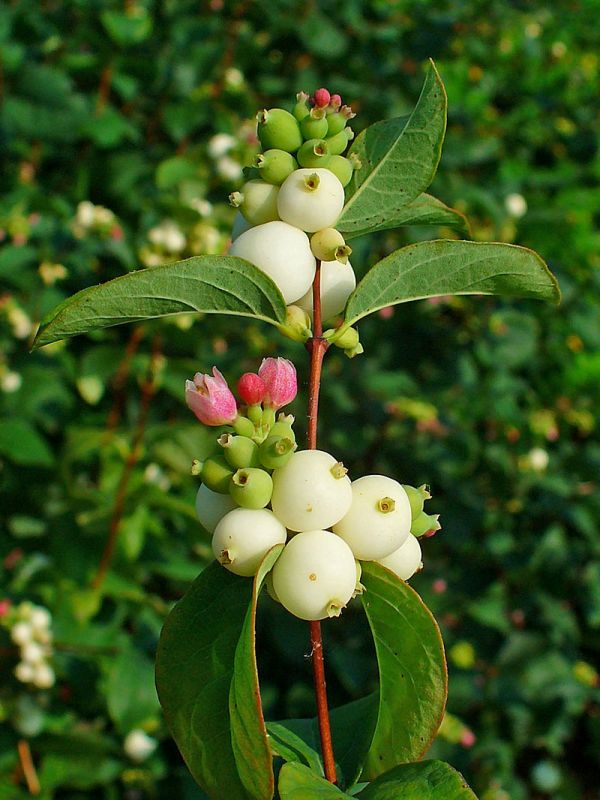
Snow-white berries (by By H. Zell – Own work)

Symphoricarpos albus or Snowberry

A deciduous shrub, spreading by vigorous suckering, widely planted in both gardens and in the wider countryside in hedges and for game cover in woodland. It reproduces by suckering and fruits freely, but regeneration from seed is unknown. 

Uses:

It can be excused for its invasive habits as it is a very useful wildlife plant and beautiful en mass with the large, long lasting white berries.

I’ve always noted many bees around the tiny flowers and according to Wikipedia: in North America; many birds and small mammals use it for food and cover. It is sometimes planted as game cover in woods, scrub, etc.

The fruit and shrub itself are poisonous to humans, causing vomiting.

Native Americans used the plant as a medicine and a soap, and sometimes for food, and the wood was good for arrow shafts. In Russia, the berries are crushed in the hands and rubbed about for a soothing folk-remedy hand lotion.

This shrub is used for erosion control in riparian areas, and it is planted in ecological restoration projects on disturbed sites such as abandoned mines.

Symphoricarpos orbiculatus or Coralberry

A deciduous shrub, spreading by suckers which grow to produce dense thickets. It is naturalized in hedges, scrub and on waste ground.

It has got attractive small pink berries, especially nice in winter.